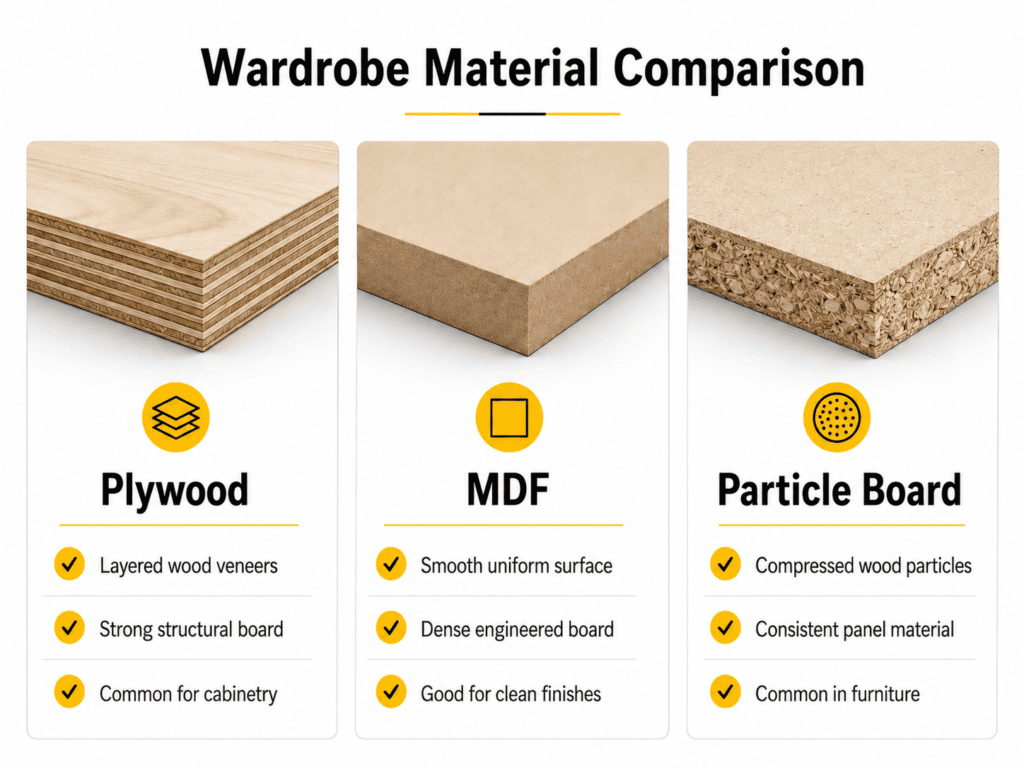
Choosing the right wardrobe material is an important part of planning a bedroom, especially when comparing custom or built-in wardrobe options in Malaysia.
Plywood, MDF and particle board are commonly used in furniture, but they are not the same. Each material has different characteristics in terms of construction, surface finish, strength and suitability for different wardrobe designs.
Instead of asking which material is simply the best, it is more useful to understand how each option differs and which one better suits your room, usage and priorities.
A wardrobe is used frequently and usually stores clothing, accessories and personal belongings for many years.
The board material used can influence how the wardrobe feels, how its surfaces are finished, how fittings are installed and how suitable it is for a particular design.
Material choice should therefore be considered together with wardrobe size, internal layout, door system, finishing and room conditions.
Plywood is manufactured by bonding multiple thin layers of wood veneer together. These layers are arranged in alternating directions to create a strong and stable board structure.
Common characteristics of plywood include:
The performance of plywood can still vary depending on its grade, thickness, manufacturing quality and finishing, so the word plywood alone does not determine the quality of the final wardrobe.
MDF stands for Medium-Density Fibreboard. It is made from fine wood fibres combined with resin and pressed into smooth, consistent panels.
One of the main characteristics of MDF is its smooth and uniform surface, which can make it suitable for selected decorative finishes and detailed designs.
Common characteristics of MDF include:
Whether MDF is suitable for a wardrobe depends on the specific application, board specification, finishing and overall furniture construction.
Particle board, sometimes referred to as chipboard, is manufactured from wood particles that are combined with resin and compressed into panels.
It is widely used in modern furniture manufacturing and is commonly finished with laminates or other decorative surfaces.
Common characteristics of particle board include:
Its suitability can vary according to board density, thickness, edge treatment, fittings and manufacturing quality.
| Factor | Plywood | MDF | Particle Board |
|---|---|---|---|
| Construction | Layers of wood veneer | Fine wood fibres | Compressed wood particles |
| Surface | Depends on veneer and finish | Smooth and uniform | Usually paired with a decorative surface |
| Structure | Layered construction with good structural strength | Dense and consistent | Consistent manufactured panel |
| Common Use Consideration | Strength and cabinet structure | Smooth decorative finishes | Practical furniture applications |
Not necessarily.
Plywood is often valued for its layered construction and structural strength, but that does not mean every wardrobe needs to be made entirely from plywood.
Different wardrobe components can have different requirements, and overall quality also depends on board specification, hardware, edge finishing, construction and installation.
MDF can be suitable for wardrobe applications where its smooth and consistent surface supports the required design or finish.
Its suitability depends on where it is used, the board specification, finishing and overall construction of the wardrobe.
Particle board is widely used in furniture and can be suitable for wardrobes when the board, fittings, edge treatment and construction are appropriate for the design.
Rather than judging a wardrobe based only on the material name, it is more useful to look at the complete furniture construction and how it is intended to be used.
Malaysia's warm and humid climate makes proper furniture care and room conditions important regardless of which wardrobe material is used.
Wardrobes should generally be kept away from prolonged water exposure, damp walls and areas with persistent moisture problems.
Good ventilation, proper installation and addressing existing moisture issues in the room can help protect the wardrobe over time.
The right material depends on more than one factor.
Before deciding, consider:
Instead of choosing a wardrobe based only on whether the label says plywood, MDF or particle board, compare the complete wardrobe design and select a solution that matches your actual needs.
If you are planning a bedroom or replacing an existing wardrobe in Perak, it is useful to compare materials together with the overall wardrobe size, storage layout and design.
Empire Home offers wardrobe solutions for different home layouts and storage requirements, allowing you to explore options based on how you actually use the space.
There is no single material that is best for every wardrobe. Plywood, MDF and particle board have different characteristics, and suitability depends on the wardrobe design, finish, construction and usage requirements.
Plywood can be suitable for wardrobes because its layered construction provides good structural strength. Final performance also depends on plywood grade, thickness, finishing and overall wardrobe construction.
MDF may be suitable for certain wardrobe doors and decorative applications because of its smooth and uniform surface. Suitability depends on the specific design, board specification and finish.
No. MDF is made from fine wood fibres, while particle board is manufactured from larger wood particles. Their internal structure and characteristics are different.
The appropriate material depends on the wardrobe design, room environment, finishing, construction and usage. In Malaysia's humid climate, keeping furniture away from persistent moisture and damp walls is important regardless of the material selected.
Material is only one part of choosing a wardrobe. Size, storage configuration, room layout and daily usage should all work together.
Explore Empire Home